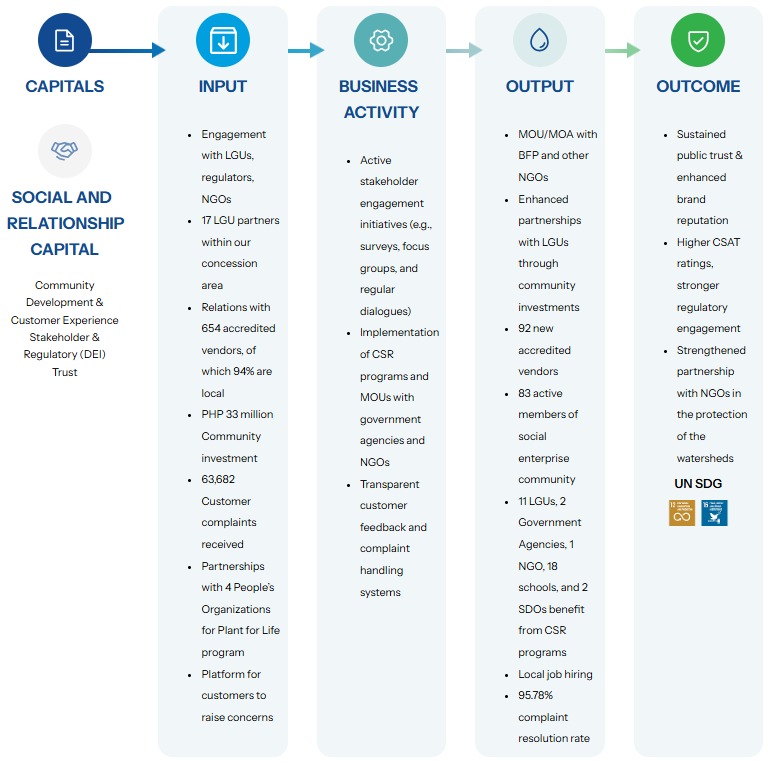
Our Performance Summary shows how Maynilad turns everyday operations into long-term value. By focusing on smart growth, greater efficiency, and strong partnerships, we’re not only meeting the needs of communities today but also building a foundation for a more sustainable and resilient future.
How Maynilad creates value
Business Growth
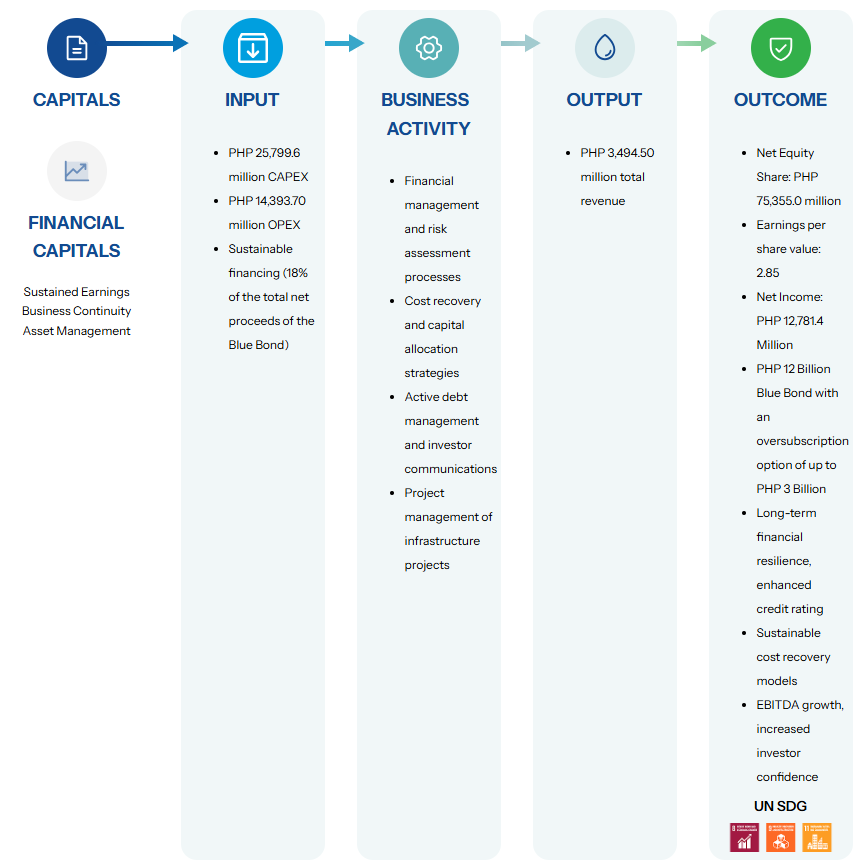
Capitals
Financial Capitals
Sustained Earnings Business Continuity Asset Management
Input
PHP 25,799.6 million CAPEX
PHP 14,393.70 million OPEX
Sustainable financing (18% of the total net proceeds of the Blue Bond)
Business activity
Financial management and risk assessment processes
Cost recovery and capital allocation strategies
Active debt management and investor communications
Project management of infrastructure projects
Output
PHP 3,494.50 million total revenue
Outcome
Net Equity Share: PHP 75,355.0 million
Earnings per share value: 2.85
Net Income: PHP 12,781.4 Million
PHP 12 Billion Blue Bond with an oversubscription option of up to PHP 3 Billion
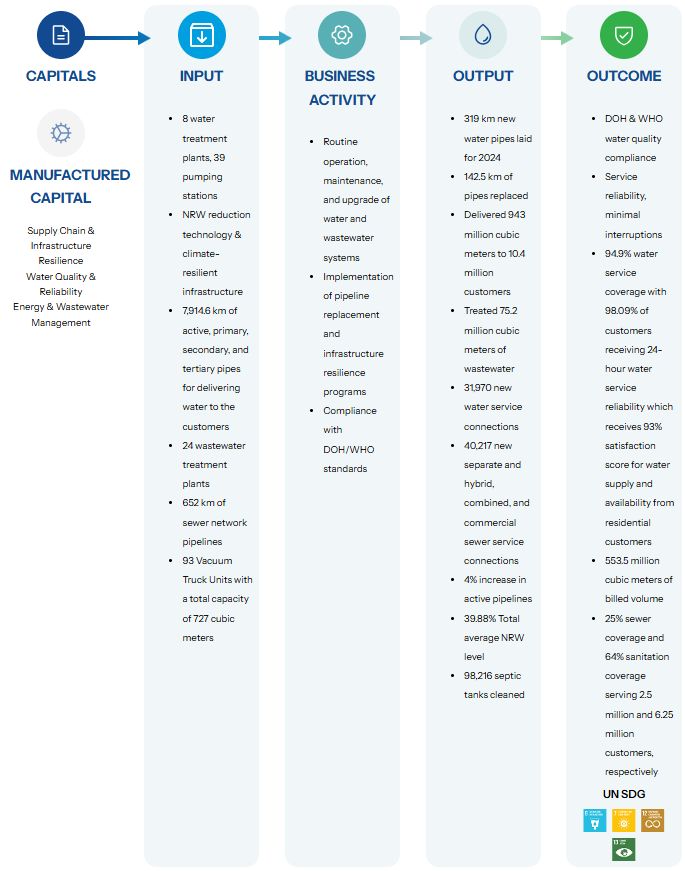
7,914.6 km of active, primary, secondary, and tertiary pipes for delivering water to the customers
24 wastewater treatment plants
652 km of sewer network pipelines
93 Vacuum Truck Units with a total capacity of 727 cubic meters
Business activity
Routine operation, maintenance, and upgrade of water and wastewater systems
Implementation of pipeline replacement and infrastructure resilience programs
Compliance with DOH/WHO standards
Output
319 km new water pipes laid for 2024
142.5 km of pipes replaced
Delivered 943 million cubic meters to 10.4 million customers
Treated 75.2 million cubic meters of wastewater
31,970 new water service connections
40,217 new separate and hybrid, combined, and commercial sewer service connections
4% increase in active pipelines
39.88% Total average NRW level
98,216 septic tanks cleaned
Outcome
DOH & WHO water quality compliance
Service reliability, minimal interruptions
94.9% water service coverage with 98.09% of customers receiving 24-hour water service reliability which receives 93% satisfaction score for water supply and availability from residential customers
553.5 million cubic meters of billed volume
25% sewer coverage and 64% sanitation coverage serving 2.5 million and 6.25 million customers, respectively
UN SDG
Capitals
Natural CAPITAL
Supply Chain & Infrastructure Resilience Water Quality & Reliability Energy & Wastewater Management
Input
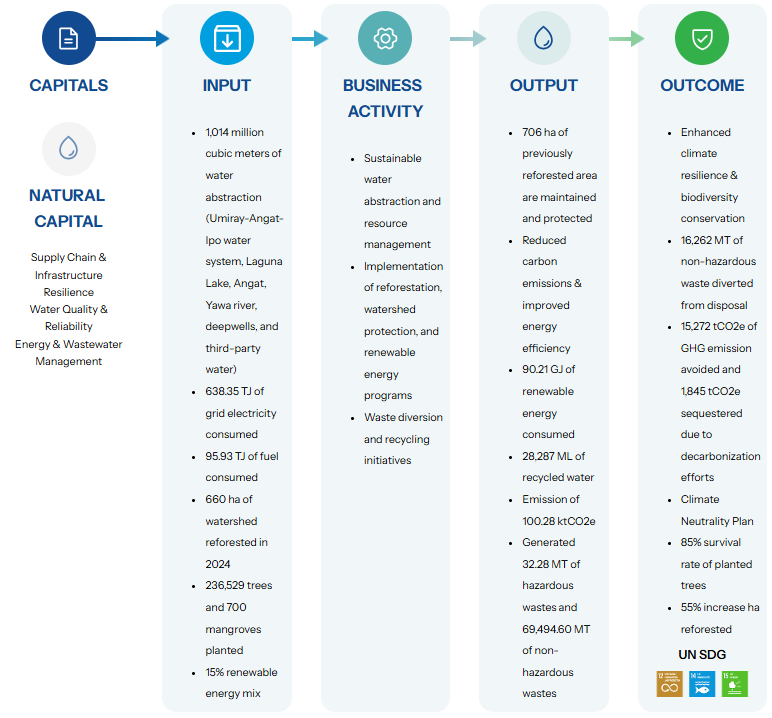
1,014 million cubic meters of water abstraction (Umiray-Angat-Ipo water system, Laguna Lake, Angat, Yawa river, deepwells, and third-party water)
638.35 TJ of grid electricity consumed
95.93 TJ of fuel consumed
660 ha of watershed reforested in 2024
236,529 trees and 700 mangroves planted
15% renewable energy mix
Business activity
Sustainable water abstraction and resource management
Implementation of reforestation, watershed protection, and renewable energy programs
Waste diversion and recycling initiatives
Output
706 ha of previously reforested area are maintained and protected
Reduced carbon emissions & improved energy efficiency
90.21 GJ of renewable energy consumed
28,287 ML of recycled water
Emission of 100.28 ktCO2e
Generated 32.28 MT of hazardous wastes and 69,494.60 MT of non-hazardous wastes
We care about your privacy. This page explains the information we and our trusted partners collect, and how it helps us improve your experience on our website. You have full control over your personal data. To learn more, please visit our Cookie Policy.
Data Collected by Our Partners
Our partners help us enhance your browsing experience through tools that collect limited information about how you use our site. This data helps improve functionality and content. You can manage or adjust your cookie preferences anytime in our Cookie Policy.
We Value Your Privacy. We use cookies to give you a better and more personalized website experience. These help us understand how you use our site and improve our services. Learn more in our Cookie Policy. By clicking “Accept,” you agree to our use of cookies.